

Mudgar is one of India’s oldest and most effective strength-training tools, deeply rooted in traditional fitness culture. Long before modern gyms, machines, and dumbbells existed, Indian warriors and wrestlers trained with mudgars to develop real, usable strength. Today, Mudgar training is making a strong comeback as people rediscover functional fitness and traditional workout systems.
This detailed guide explains everything you need to know about Mudgar — its history, structure, benefits, training methods, and why it remains relevant even in modern fitness.
Introduction to Mudgar
A Mudgar is a heavy wooden club traditionally used for strength and conditioning exercises. It has a thick weighted end and a handle designed for gripping while performing swinging movements around the body.
Unlike modern gym equipment that focuses on isolated muscles, Mudgar training involves dynamic, rotational movements that engage multiple muscle groups at the same time. This makes it a powerful tool for building strength, coordination, endurance, and mobility together.
Mudgars are typically made from hardwood such as mahogany or teak to ensure durability and balanced weight distribution.
Historical Background of Mudgar Training
Mudgar training originates from ancient Indian physical culture and was widely practiced in akhadas, the traditional wrestling schools of India. Indian wrestlers, known as Pehlwans, used Mudgars daily to develop powerful shoulders, strong grip strength, and exceptional endurance.
Historical records and sculptures show warriors and wrestlers training with club-like tools thousands of years ago. These exercises were not only meant for physical strength but also for improving combat readiness and joint resilience.
During the colonial period, Indian club training spread internationally and influenced physical training systems in Europe and America. However, heavy Mudgar training remained uniquely associated with Indian wrestling traditions.
Structure and Design of a Mudgar
A traditional Mudgar consists of three main parts:
Handle:
The narrow section designed for grip control. Proper handle thickness ensures safe swinging and prevents slipping.
Body:
The elongated section connecting the handle to the weighted head. Its length determines leverage and difficulty level.
Weighted End:
The thicker portion that creates resistance during swinging movements. This uneven weight distribution makes Mudgar training highly effective for functional strength.
Mudgars vary in size and weight, ranging from light beginner clubs to extremely heavy traditional training tools used by advanced practitioners.
How Mudgar Training Works
Mudgar exercises rely on circular and rotational movements rather than straight lifting patterns. When you swing a Mudgar, your body must stabilize and control momentum throughout the motion.
This activates multiple systems simultaneously:
- Shoulders and rotator cuffs stabilize movement
- Core muscles maintain balance
- Forearms and grip control rotation
- Back and chest assist in directional control
- Legs provide grounding and stability
Because the weight moves around the body instead of vertically, muscles work in coordination rather than isolation.
Types of Mudgar Exercises
Mudgar training includes a wide variety of movements. Some of the most common patterns include:
Basic Swings
Large circular swings around the shoulders that build endurance and coordination.
Shoulder Rotations
Controlled rotations improving mobility and joint health.
Front and Back Swings
Develop upper body strength and posture control.
Flow Movements
Continuous rhythmic movements combining strength and flexibility.
Single-Hand Training
Advanced technique improving grip strength and unilateral stability.
Muscles Worked During Mudgar Training
Mudgar workouts are full-body in nature. Major muscle groups involved include:
- Shoulders and rotator cuff muscles
- Upper back and lats
- Chest muscles
- Core and obliques
- Forearms and grip muscles
- Arms and stabilizers
- Hip and leg stabilizers
This makes Mudgar training closer to athletic conditioning rather than bodybuilding.
Benefits of Mudgar Training
Mudgar training offers advantages rarely achieved through conventional gym workouts.
Functional Strength Development
Builds strength useful for real-life movements instead of machine-based strength.
Improved Shoulder Mobility
Rotational movements strengthen joints while improving flexibility.
Injury Prevention
Strengthens stabilizer muscles often ignored in modern workouts.
Grip and Forearm Strength
Continuous control of momentum significantly improves grip endurance.
Fat Loss and Conditioning
High-repetition swinging increases heart rate and calorie burn.
Posture Improvement
Strengthens upper back muscles responsible for maintaining posture.
Mental Focus and Coordination
Rhythmic training improves body awareness and concentration.
Mudgar vs Modern Gym Equipment
Modern gym exercises often isolate muscles using controlled machines or linear lifting movements. Mudgar training differs fundamentally.
Gym weights move up and down against gravity. Mudgars move around the body, creating rotational resistance. This forces muscles to stabilize continuously, making workouts more dynamic and athletic.
While dumbbells build muscle size efficiently, Mudgars develop mobility, endurance, and coordination alongside strength.
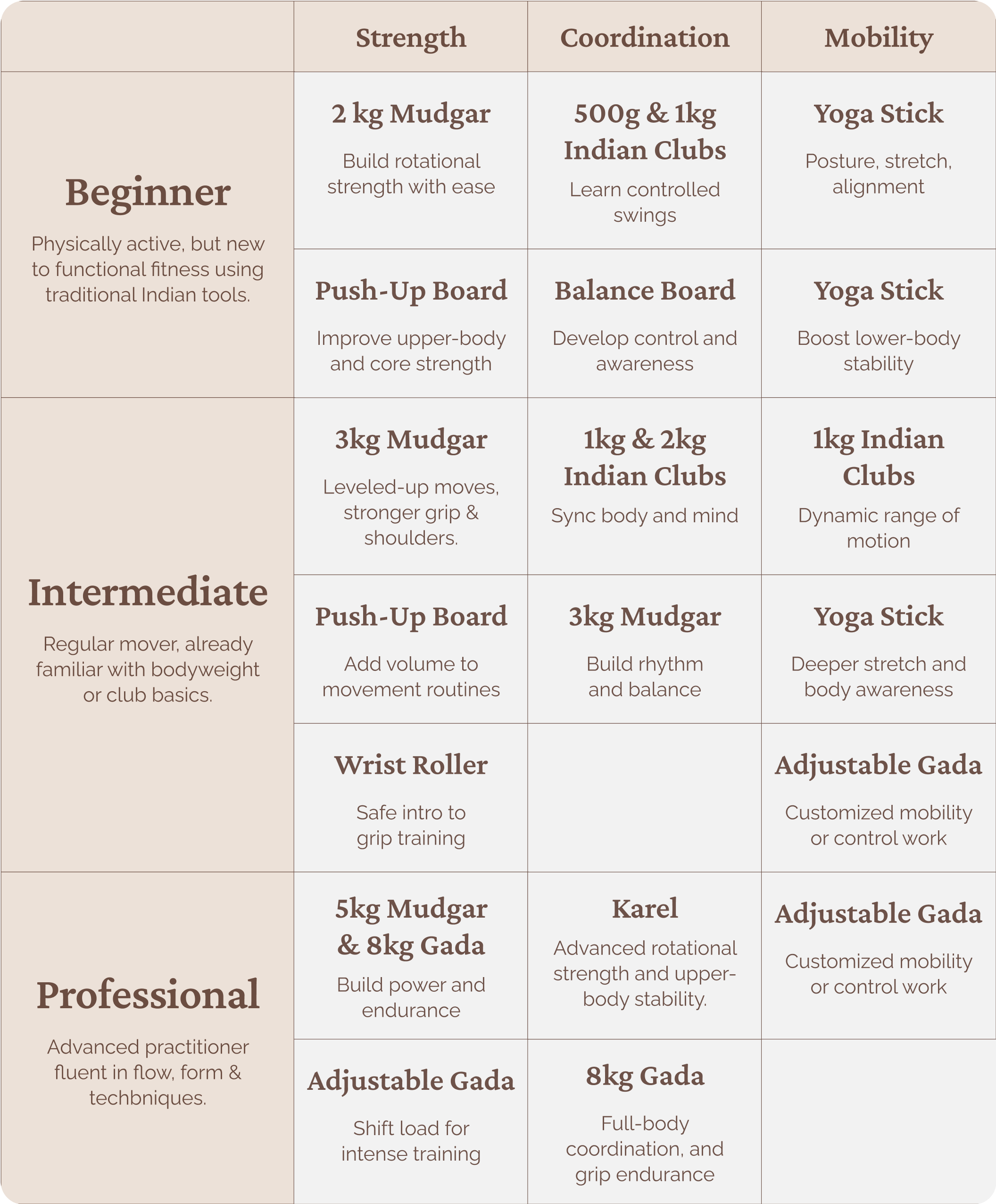
Choosing the Right Mudgar Weight
Selecting proper weight is essential for safe training.
Beginners:
2 kg to 5 kg Mudgar
Intermediate Practitioners:
5 kg to 10 kg Mudgar
Advanced Users:
10 kg and above
Starting light helps you learn movement control before progressing to heavier weights.
Beginner Mudgar Training Routine
A simple beginner routine may include:
- Warm-up mobility exercises
- Two-hand basic swings
- Shoulder rotations
- Controlled front swings
- Light flow sequences
Practice for 10–15 minutes initially and gradually increase duration as coordination improves.
Consistency matters more than heavy weight in Mudgar training.
Safety Tips for Mudgar Training
Proper technique is crucial due to rotational momentum.
Maintain a firm grip at all times.
Keep movements slow and controlled initially.
Ensure enough surrounding space while training.
Avoid sudden jerks or excessive speed.
Warm up shoulders and wrists before practice.
Learning movement patterns correctly prevents strain and improves long-term results.
Why Mudgar Training is Returning Today
Modern lifestyles have led to reduced mobility and increased joint issues, especially in shoulders and posture. Functional training systems like Mudgar address these problems naturally.
Fitness enthusiasts, athletes, martial artists, and rehabilitation specialists are increasingly adopting traditional tools because they combine strength, movement, and longevity.
Mudgar training represents a balance between ancient wisdom and modern fitness needs.
Conclusion
Mudgar is far more than a traditional exercise tool. It is a complete strength and conditioning system developed through centuries of practical experience.
By combining strength, mobility, endurance, and coordination, Mudgar training offers a holistic approach to fitness that modern workouts often lack. Whether you are a beginner seeking functional fitness or an advanced athlete aiming to improve performance, Mudgar training provides a powerful and sustainable path toward physical strength and resilience.
If practiced consistently with proper technique, Mudgar can transform not only muscular strength but also overall movement quality and long-term joint health.



Hi, this is a comment.
To get started with moderating, editing, and deleting comments, please visit the Comments screen in the dashboard.
Commenter avatars come from Gravatar.